

The BIG CON...
PART 3. Parables of Managed Reality - An MOR series

The full series :


This piece (and the next one) explain how confidence games work.
It is an important topic because confidence games operate at different scales.
On the micro level—what is examined here—the underlying principles and techniques of con artists can be made obvious.
Those who manage your reality on the global scale understand this science; can you afford not to?
Some have conscience, some others have
con science. Beware…
— Vincent Okay Nwachukwu
The ‘big store’ con: origins
Let the background ripple like a stirred pond and take yourself back to the late 19th century, an image of Cheyenne, Wyoming settling in your mind’s eye.
It was the year 1867 and the Union Pacific Railroad had just arrived, so it was no longer the middle of nowhere. Yet this was still the Wild West, with its “mud streets” lined by “close-packed frame buildings … ridiculous in their raw elegance,” and “shacks and tents of the myriads of adventurers” darning the outskirts. But no matter. Cheyenne had ambitions, quickly swelling from a frontier town into a “teeming little city, sprawling on the plateau like a heavily muscled giant in a suit too small, threatening momentarily to burst every seam.”
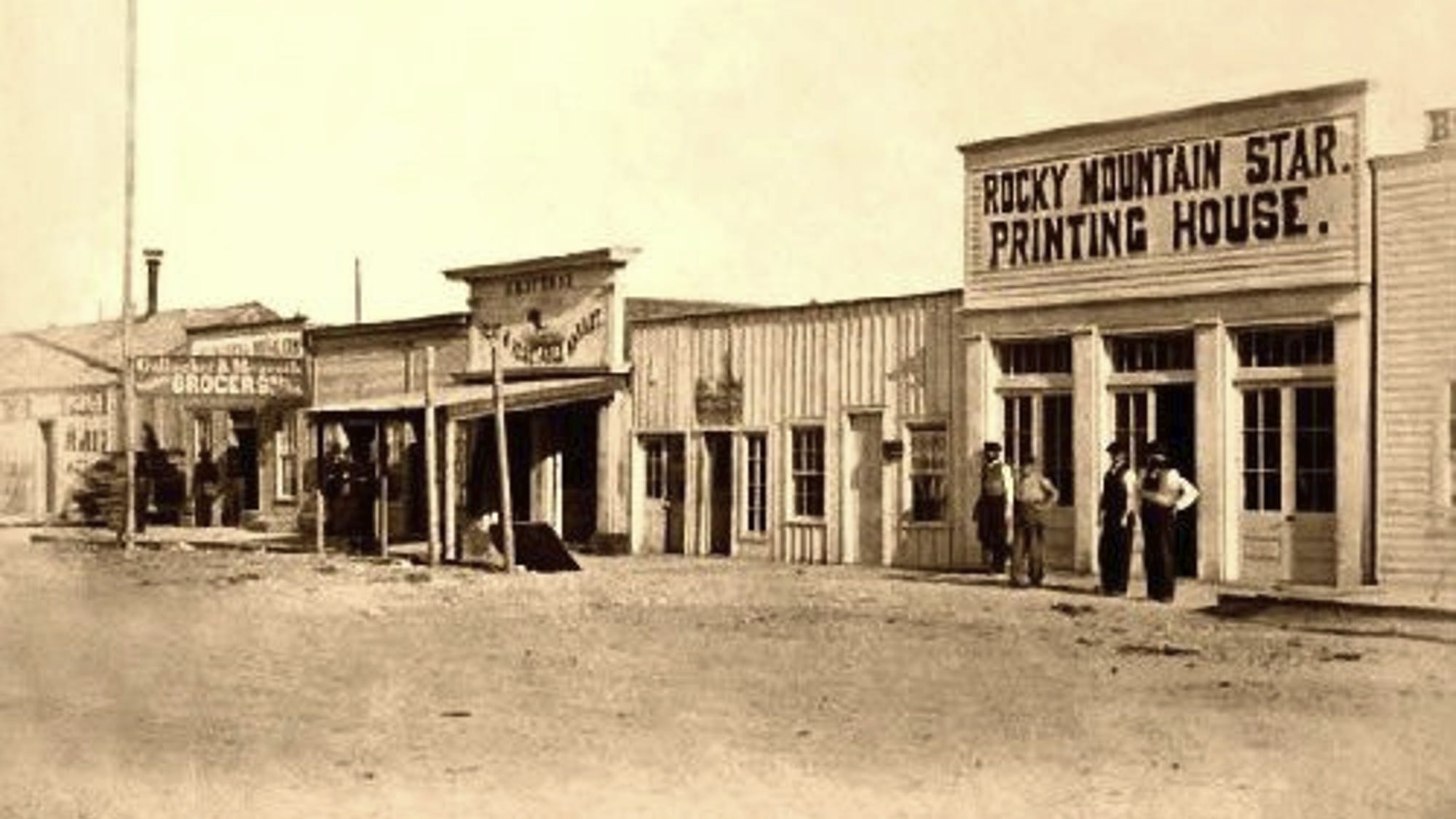
None could doubt Cheyenne’s energy and cosmopolitanism.
“In the dust-swirled streets cattlemen, miners, laborers, engineers, land speculators, soldiers and gamblers surged in a tangle of men, horses and material; the gunman elbowed the itinerant evangelist and the Oriental jostled the American Indian. Over the odor of horses and men and raw whisky and wood smoke there hung a more elusive smell, one which emanated from the fevered blood of the men and tainted the air with an electric quality. It was the odor of an ancient lust, the lust for easy money.”1
The easiest money flew right out of the pockets of those most eager for it. That’s something Ben Marks understood. He’d take a board out, set it on a stool, throw three cards down, face up, and invite the spectators—charmed into a crowd around him by his energy, quick wit, and spiel—to bet they could find the queen. Then he’d turn the cards down and move them around. Someone would right away bet a dollar and find her—that was a shill (accomplice), whose job was to convince others they could win. “More and larger bets were taken; meanwhile, another accomplice had located a fat sucker.”
The fat sucker needed to feel superior—smarter—or he wouldn’t bite. So the second accomplice would suggest to him, by way of providing a friendly service: Hey, why not ask to examine the cards and surreptitiously bend the corner of the queen while we do it. This made the fat sucker feel clever and confident. “When the bet had been run up high enough, the trick was tried, but Ben deftly removed the ‘ear’ from the marked card and put it on another as he manipulated the cards. The player was dumbfounded when the queen evaded him.”
This famous game, three-card monte, had come up from Mexico. But in North America, land of enterprise, any good idea becomes an industry. “Why not set up a place of business of his own? Why not operate from a permanent base, let the players come to him?” This brainstorm, writes Maurer, “was to become the backbone of all big-time confidence games.”

But that would come later; Ben Marks himself started small. He opened, “in a shack of a building, what he called The Dollar Store.” Everything in that store, “colorful, useful, and even valuable merchandise,” was sold for one dollar to bring in a steady stream of customers. But as soon as you walked in, Ben would deftly switch your interest to various monte games happening inside the store, “replete with shills and ‘sticks’ to keep the play going at a lively pace.”
Voilá: the ‘big store’ con.
Worthy of Hollywood, but not science?
From this simple idea, in due time, vastly more sophisticated swindles would evolve, but they would all be known as ‘big store’ cons in tribute to Ben Marks, for they preserved the basic structure of his innovation in Cheyenne: build a little world and the suckers will come. Except these little worlds would grow in artistry and sophistication to become bona-fide alternate realities created exclusively for the ‘mark’ to inhabit, and requiring, for their staging, large and professional—and expensive—production crews. As Maurer says with admiration unconcealed, and quite justly,
“the modern big store is a carefully set up and skillfully managed theater where the victim acts out an unwitting role in the most exciting of all underworld dramas. It is a triumph of the ingenuity of the criminal mind.”2
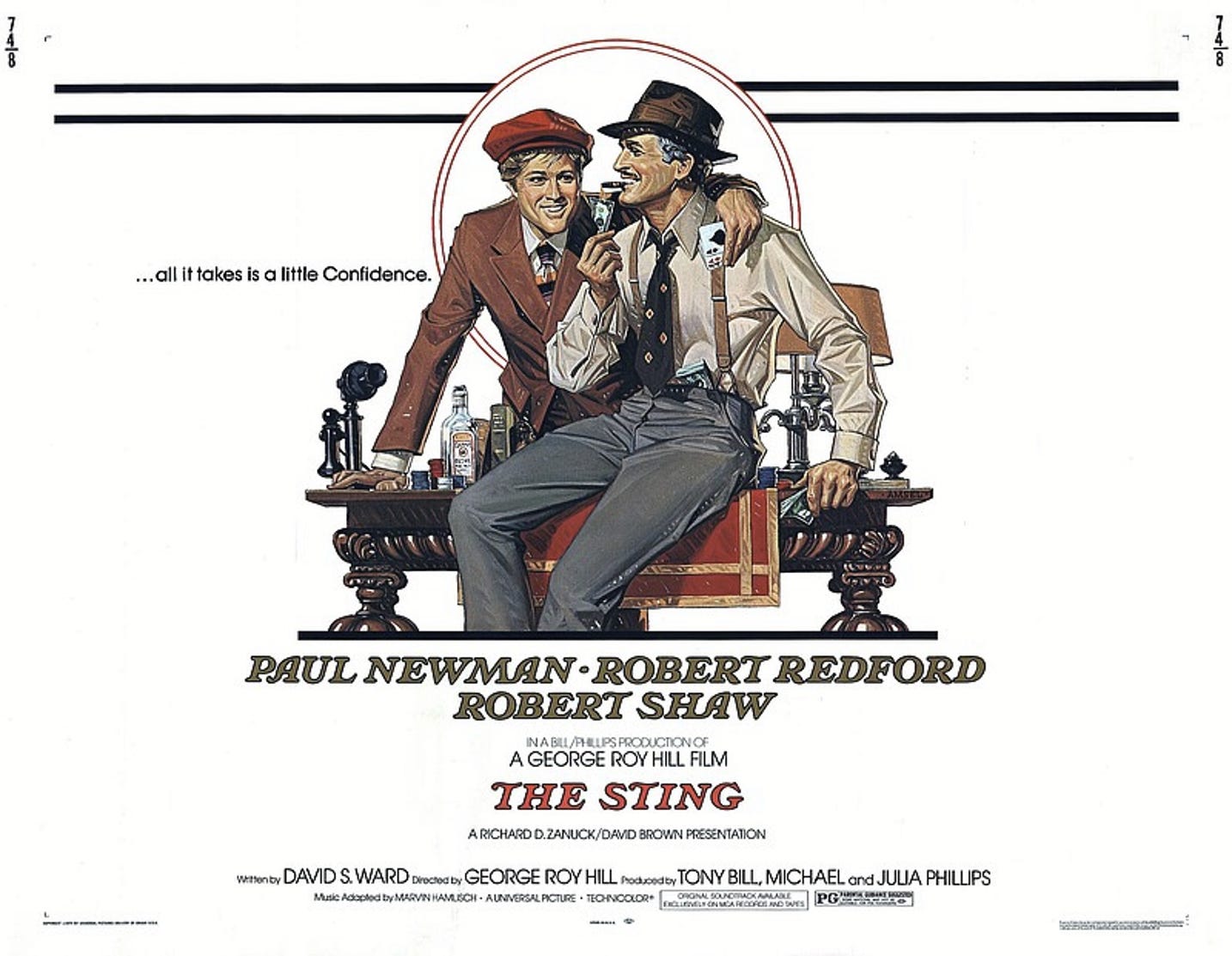
’Tis a Hollywood weakness, the big-store con, and it graces many famous films, old and recent. My soft spot is for the first one, George Roy Hill’s classic The Sting (1973), with Robert Redford and Paul Newman in the leading roles and 7 Academy Awards including best picture (if you care about that). It is set in the 1930s, in the context of horse racing.
It was the Great Depression then, and fully twenty-five per cent of wage-earning US citizens were unemployed as the new decade began. Race-fixing scandals early in the century had brought a ban down on most horse racing, but now, with desperate souls hoping for easy money and bankrupt state governments eager to tax the winnings, racing was re-legalized and became all the rage again. By the time old-and-damaged but can-do Seabiscuit closed this doldrums decade, heaving his neck across the finish line with a supremely unlikely—hence immortal—win in the 1940 Santa Anita Handicap, horseracing, no less than economic penury, had helped to define an American era.3
As did the wire, the big-store con built around horse racing and set in the ‘horse poolroom,’ so named after the nineteenth century betting parlor which had included “pool tables … so patrons could pass the time between races.”4
Around this and other big-store cons, in the first few decades of the 20th c., an entire criminal subculture flourished, garlanded with its own special dialect, normative rules, code of honor, and prestige structure. That is the culture that David W. Maurer chronicled in his masterful ethnography The Big Con: The Story of the Confidence Man, the book that inspired and informed the very film I just recommended: The Sting.
But even as Maurer published his book in 1940, the criminal culture he chronicled was fading already, though Hollywood longingly insists that the entire subculture mutated, adapted, and survived, inventing new forms of the long-form con for a changed environment.
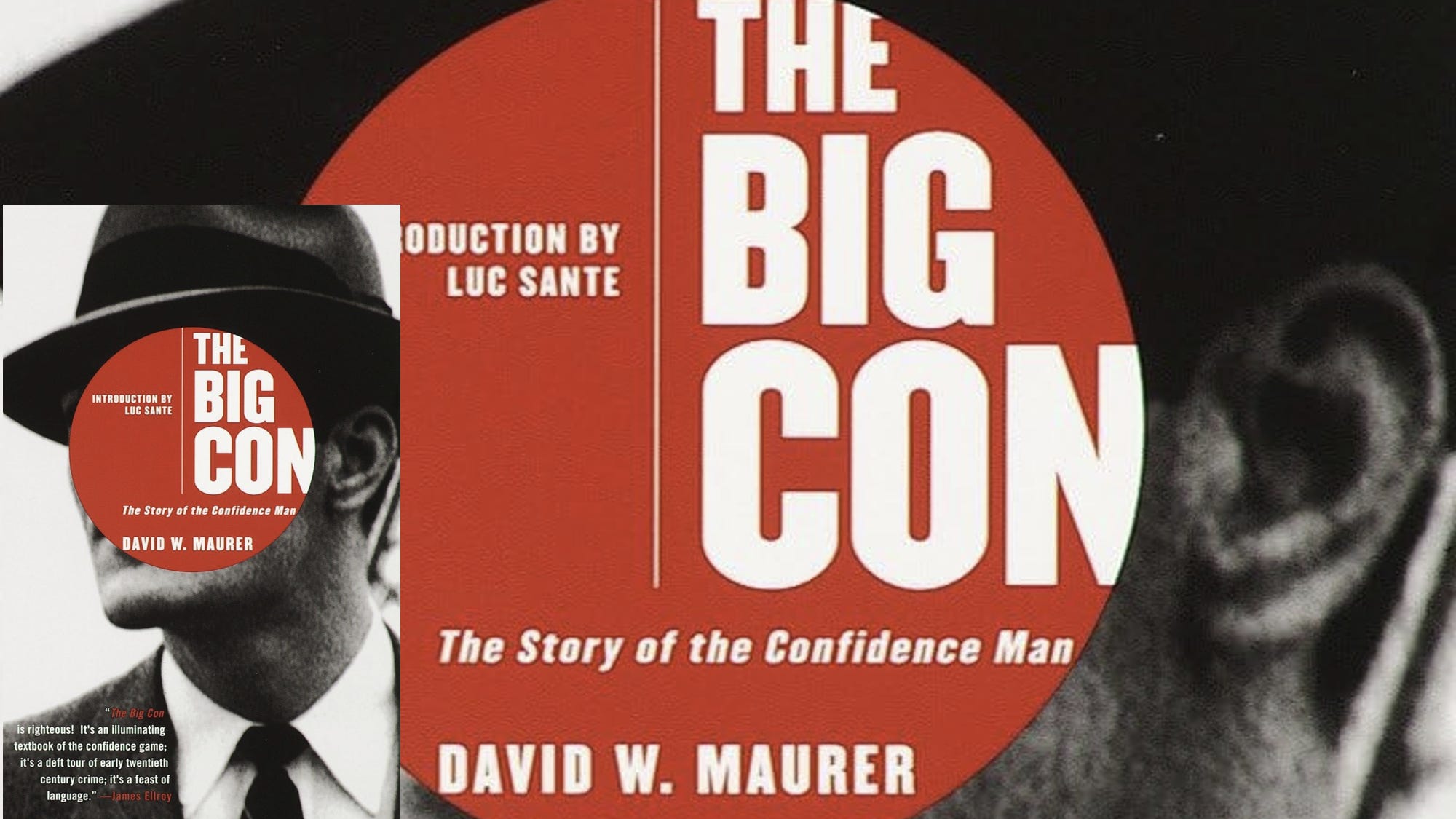
Maurer came to his subject by way of his trade, linguistics, as he initially meant to study the special lingo of con artists, whose parallel and expanded vocabulary was so vast that an insider conversation was unintelligible to non-connoisseurs. By the by, Maurer became so fascinated with the con and its perpetrators that he was sucked into doing anthropology. As his informants, most ironically, gained confidence in his scientific integrity (a trust he never betrayed), he got to hear their stories, and from these testimonies emerged a landmark work of social science on an otherwise neglected major aspect of modern social life. Ned Polsky, an important criminal sociologist specializing on hustlers and grifters, later called Maurer’s work “a model of sociological sense” that “put[s] the criminologist to shame.”5
The big-store con is a crime, but, as Maurer says, it is also a form of theater. They really are con artists. For they must build an alternate world for the mark to inhabit, requiring skilled stagecraft and exacting choreography, sublime in its talent and details.
The big-store con is also applied science, for only a large body of field experiments can teach the con artist how to stimulate the mark’s imagination in just the right ways. Maurer lavishes considerable attention on what the con artists themselves, in their own lingo, call grift sense: the requisite skills to lure and fleece an item of prey. Just as a magician must understand the psychology of attention, a con artist must grasp how humans put together a running construct of reality, and must know which perceptual and reasoning biases may induce gullibility. Maurer’s study of the big-store con is thus an education into these aspects of human psychology.
Maurer also found something that victims of con artists always find hard to believe (and that is why they become prey): that an investment so enormous in fooling the mark would ever be attempted by anyone. They somehow cannot conceive that con artists possess a Zen-master’s patience and hunter’s talent for “stalk[ing] their quarry.” They need this supremacy through patience and persistence because, “although marks may be plentiful, they do not walk heedlessly into the traps of the confidence men. They must be stalked for days and even weeks before the kill.”6
But I’ll get out of the way. Because, as Maurer shows, this is all best learned by plunging into the story of an archetypal con. We’ll need a horse poolroom. This way please…
The wire: the setup
You hear patrons chinking glasses and spot the bar at the end as you enter the smoke-filled room. You see a bookmaker taking bets from behind a window, and off to one side is a blackboard where the results of the race will be written. Those results will soon be called by the loud voice now declaiming—at an auction-fast clip—the breakneck progress of the race.
Remember: this is the 1930s. Yes, telephones are in increasingly widespread use and the radio networks are growing, but for some purposes this is still very much the world of the telegraph. The caller you hear is not coming through the radio; he is but a few feet away, reading from a strip of paper that grows in his hand as a telegraph ‘ticker’ spits it out with the real-time details of the race, to which he adds emotion in a fevered play-by-play that simulates an eyewitness and expertly fuels the excitement of the gamblers.
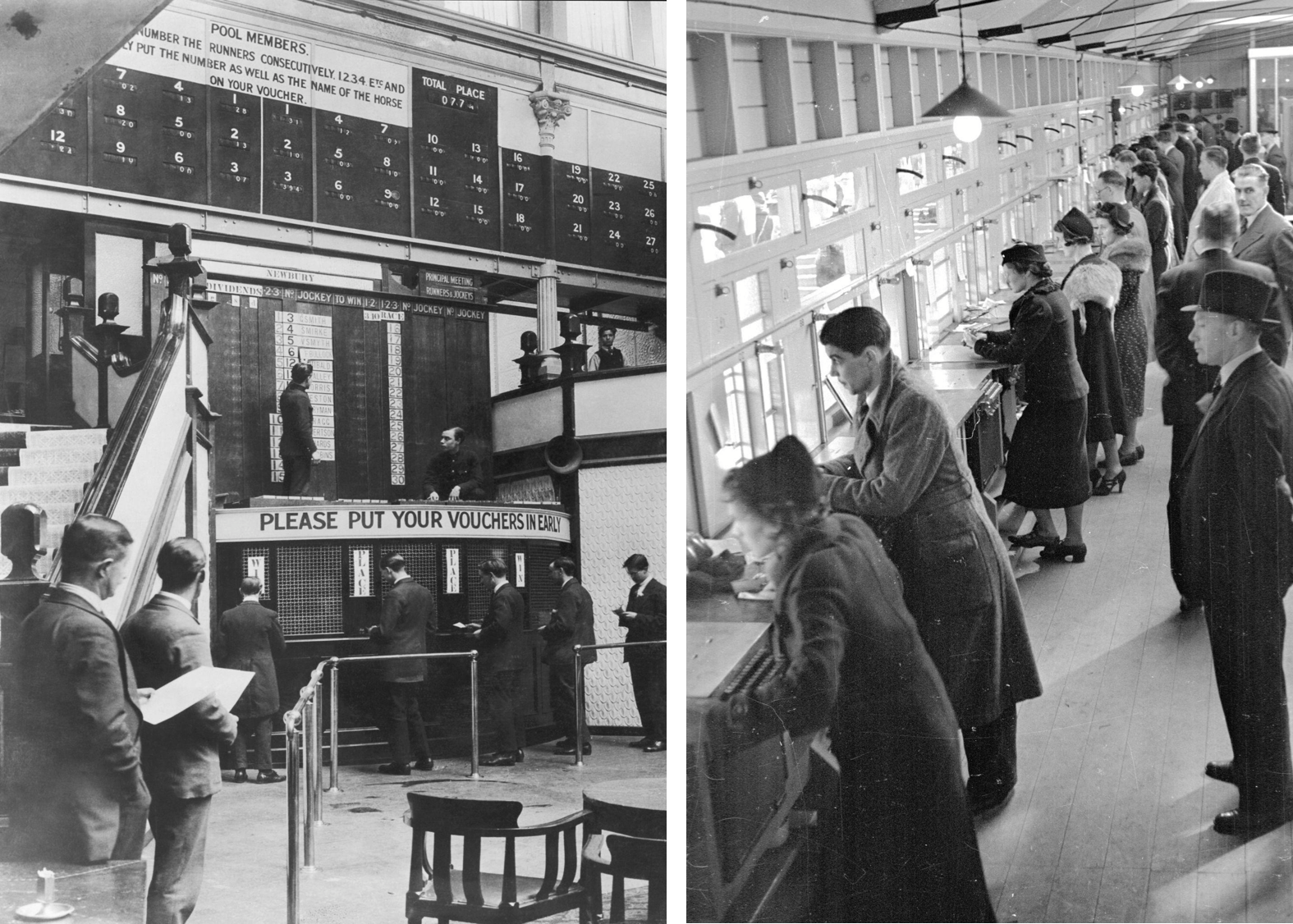
Springtime Surprise is gaining on the leader! This is the final stretch! Springtime is gaining but Lock ’n Load is still ahead! Glory is a distant third but closing in rapidly! Lock ’n Load and Springtime! Springtime and Lock ’n Load! Now it’s Springtime lunging ahead by a neck but Lock ’n Load is not conceding! Glory catching up fast but we are almost there! And it’s over! Lock ’n Load wins it by a nose!
(It’s a poor substitute for live TV, but these people don’t know that.)
Mr. John Bates, a moderately successful businessman owner of a small department store in Providence, Rhode Island, has come to this decidedly aristocratic horse poolroom in New York in the company of a recent acquaintance, one Louis Sanborn. They can see that “prosperous gentlemen are winning and losing large bets nonchalantly. The caller calls the races with great zest. Bets of $10,000 to $20,000 are laid casually.” To keep that in context, a $20,000 bet in 1935 is like laying down over a million dollars today, as I write in 2026.7 So that’s the kind of place they’re in: a temple, appointed in the finest luxury, for the ultrarich to sacrifice their money.
“Very large amounts of cash are changing hands like nickels in a crap game. Everywhere there is cash. The patrons peel off large bets from fat bank rolls or from bulging wallets. The cashier counts out $40,000 winnings without batting an eye. Louis [Sanborn] and Mr. Bates are much impressed.”8
In fact, these two are quite out of their element. But today, Mr. Bates is a betting man. He’s got $10 on Seabiscuit to win and makes $50. Pleased but not too surprised, he makes another 4-1 bet on the next race: $50 on War Admiral to win. He makes $250. Sanborn, meanwhile, has done the same.
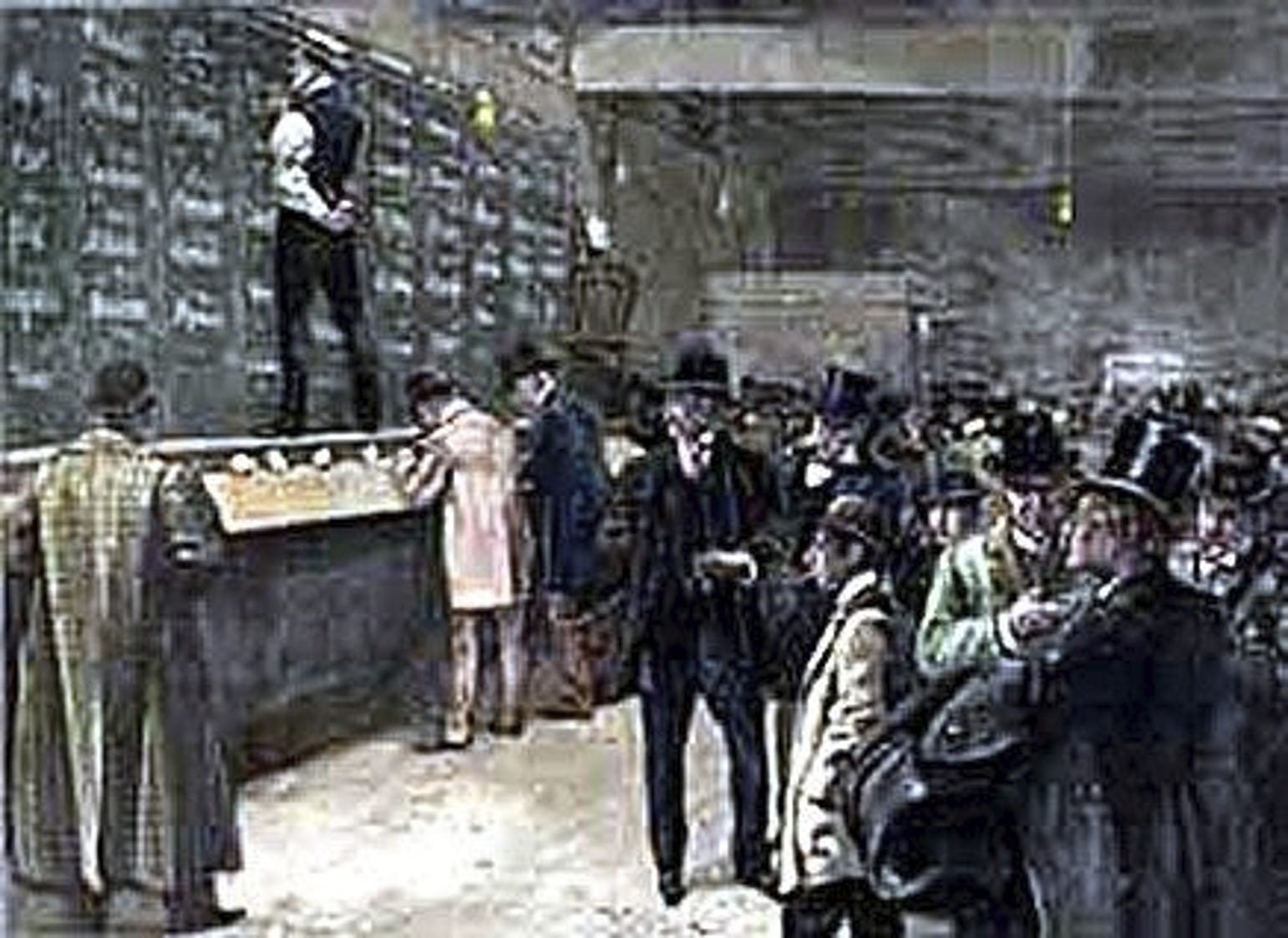
They are both excited, but Bates is the more agitated of the two. He is sure of it now: he will win every time. He’ll bet the whole $250 on the next race. He likes Challedon to win. Sanborn urges caution; Bates will not be dissuaded. He goes to place another bet, but this time too many others beat him to the line and it’s moving slowly. He may not get to the window in time.
“He grows impatient. Time is short. The race will be called any moment now. He pushes the line along, but it doesn’t seem to move fast enough. He shifts his weight from one foot to the other and peers ahead. Only one man, now. Laying a fifteen-thousand-dollar bet. Will he never get that money counted down?”9
The race is called. Bates didn’t get to place his bet. Challedon has indeed won, paying 6-1. Winnings forgone equal to $1,500 (about $85,000 in 2026). Bates is jumping with a strange mixture of disappointment and excitement.
But what is going on? Why is Mr. Bates so sure, each time, that he is betting on the right horse? Does it have anything to do with his and Sanborn’s quick exits between races to the payphone at the next-door drugstore?
Let us fill in the back story that brought them here.
The wire: the backstory
Louis Sanborn, on behalf of a large corporation in New York, expressed interest in John Bates’ department store in Providence. There was some haggling, an attractive offer, and Bates’ finally agreed to sell. So they came to New York to consummate the deal with the corporation’s lawyers, who, as it turned out, were busy with another deal on this day and wouldn’t be available till the morrow. Or so Sanborn explained to Bates after getting off the phone.
To the horse poolroom, then? Not yet.
Sanborn mentioned his cousin Charley Maxwell, “just around the corner,” who ran the central office in New York for the mammoth telegraph quasi-monopoly, Western Union. “I think you’ll like Charley,” he said. Why not pay a visit? Why not? There was time to kill and it would be slayed.
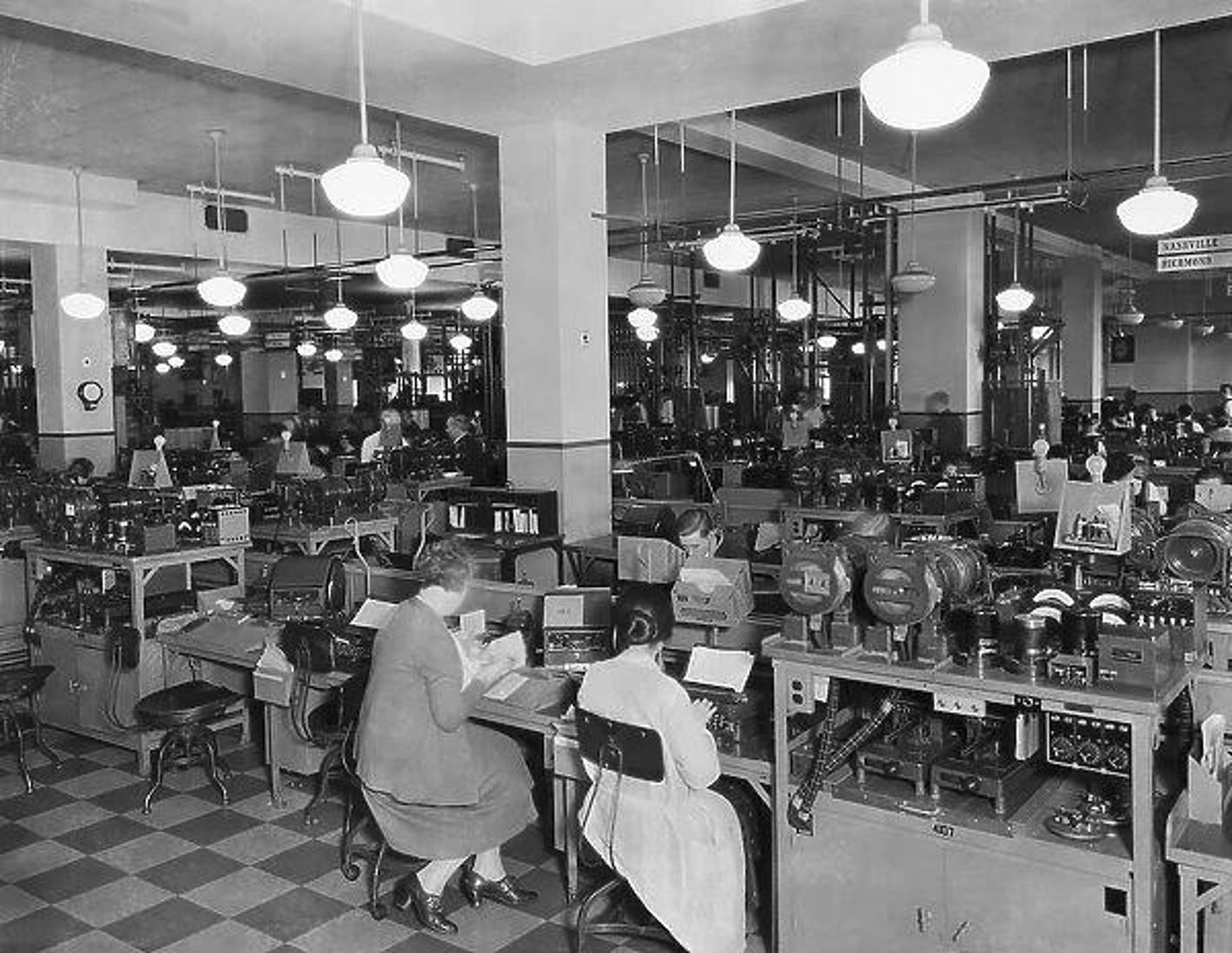
At Western Union central office they found Maxwell busy amid whirring teletypes, directing a large staff of noisy telegraphers, with much activity to and fro. As advertised, Maxwell was likeable. But he couldn’t talk just now. Any minute, he cheerfully shared, there would be a scheduled inspection of his office, so his pending business with Sanborn (the reason Sanborn had wanted to go there) would have to wait. Could his two visitors go ahead to their hotel? He would join them afterwards.
As the three chatted later in the hotel lobby, Maxwell took a break from small talk to inquire with his cousin, Sanborn, about a certain Mr. Brown, who, through Sanborn’s good offices, was scheduled to participate in a business deal with them (this was their pending matter). It was not to be. Brown, Sanborn explained, was unaccountably out of town for two weeks—a no show. Maxwell was crestfallen. But perhaps Mr. Bates here…, Sanborn gingerly suggested.
With a start, and a bit impolitely (Bates was right there), Maxwell asked: “How long have you known this gentleman, Louis?” Sanborn vouched for his new acquaintance as a “responsible man, with his own business in Providence.” Well, fair enough, but Maxwell was still reluctant. At length, however, Maxwell was persuaded at least to broach the matter, though perhaps it were better, he suggested, if they first ascended to Sanborn’s suite to discuss it privately.
For many years, Maxwell explained to Bates, though he had worked hard and well, his bosses at Western Union had repeatedly passed him over for promotion, and so, tired of being underappreciated, he planned soon to resign. But,
“ ‘I will not be poor. I know how to swing a deal by which I can make a very good profit without hurting my company in the least. But I must have the assistance of an honest and dependable man, one who is able to put up some funds in return for a share of the profits. Louis’ friend, Mr. Brown, was the man I had in mind. Now he cannot be located. I must act quickly, for I may not have the opportunity a second time. Are you interested?’ ”10
Here Bates had become a tad uncomfortable, but he kept listening. Maxwell was, after all, sharing some fascinating particulars. Namely,
“[That] through his central [Western Union] office pass the race results for all the bookmakers in the city, that the horse-poolrooms are growing fat on the profits from gambling on races, that rich men with inside information can win through the bookmakers, but that the poor fellow with only a form-sheet to guide him always loses more than he makes. [Maxwell] has worked out a system whereby he can beat the bookmakers at their own game by delaying the results long enough to ’phone them to his assistants who are to be stationed next door to the poolroom and who will bet on the races after they are run. Then the results will be released, and of course their bets will pay a very neat profit. And no one will suffer but the rich and dishonest bookmakers.”11
That was all very interesting. It even seemed like… justice. What then?
Maxwell wanted to know if Sanborn and Bates would agree to test the system in the horse poolroom. The test was simple: before betting was closed for each race, they’d take a quick dip into the drugstore next door to use the payphone and get the winning tip from Maxwell. Then they would have three or four minutes to place a bet—small bets, for now. “If it works out, we will want to try something bigger,” Maxwell had said.
We’ve now caught ourselves up with our opening scene: Sanborn and Bates in the horse poolroom, system test complete.
The wire: the swindle
Bates is ready and eager to make up for winnings forgone in the last race, when too many bettors obstructed him from the cashier. But now something else stands in his way.
“A suave-looking gentleman approaches them. He is quiet, polite, but authoritative. And just a little condescending. Mr. Bates doesn’t know just why, but he feels embarrassed. ‘Are you the gentlemen who have been placing these small bets?’ he asks, waving a pair of slips. ‘We just made a fifty-dollar bet, if you call that small,’ says Louis [Sanborn]. The manager looks at them with patronizing good nature. ‘Well, I’ll have to ask you not to place any more small bets here,’ he says. ‘We have other poolrooms for working men. Small bets make too much bookkeeping for us.’ He smiles and gently starts them toward the door. Mr. Bates feels patronized. He doesn’t like it. ‘How much does a man have to bet here?’ asks Louis. ‘A thousand dollars is usually the lower limit,’ answers the manager, smiling. ‘Beyond that, you can go as high as you like. Come back, gentlemen, some other time.’ ”12
Mr. Bates silently vows to himself that he’ll indeed come back. Working men, he said? He’ll show them. First, however, they meet again at the hotel with Charley Maxwell.
That poolroom, Maxwell explains, does some heavy business. “They can lose a million and never miss it. My plan is to take eight or nine hundred thousand in four or five days, then quit. What do you gentlemen say?”
They are in!
There is, however, the question of capital. The other two are salaried men, so it’s up to businessman John Bates. How much cash can he raise? Mr. Bates calculates what he can get from selling his bonds and decides he could get $25,000 within the next two days (almost $1.5 million in 2026). It would have to be in the form of a draft from his banker, but Maxwell says that’s fine. There is some haggling on the division of the spoils. In the final formula, Bates and Maxwell split 90% of the profit, with a 10% ‘finder’s fee’ for Sanborn.
Bates must go in person to get the money, but there is the other matter: he was to meet Sanborn’s corporation lawyers about selling his department store. “Don’t worry about that,” says Sanborn. “I’ll take care of everything for you. Just send me a telegram as soon as you know when you’ll be back and I’ll fix things up at the office.” Three days later Bates arrives back in New York with the money. And soon Sanborn and Bates are “haunting the ’phone booth” at the drugstore, waiting for Maxwell’s call. Their flesh is crawling with excitement.
At last the phone jangles. Mr. Bates rushes into the booth. It is Maxwell.
“Hello,” he says, “is that you, Louis?”
“No, this is John Bates.”
“Well, I’ve got the winner. Hurry right on over and place the money on Flying Lill. Call Louis to the ’phone, will you?”
Louis talks briefly to Charley.
“O.K.,” he says. “I understand. Place it all on Flying Lill. Good-by, Charley.”
At the horse poolroom, the odds-board has Flying Lill paying 5-1. Louis takes the money from Bates’s sweaty hands and tells the cashier, as he pushes the money through, “Flying Lill to win. Twenty-five thousand.”
“They’re off!”, yells the caller as the ticker printout grows in his hands. Bates’s mouth goes dry as every movement of this race is called—a few seconds that feel like a lifetime. Flying Lill is doing well, challenging the lead horse. He could win. They approach the finish line… It won’t happen! The winner is… Unerring by a length. Flying Lill second. Lady Maryland third.
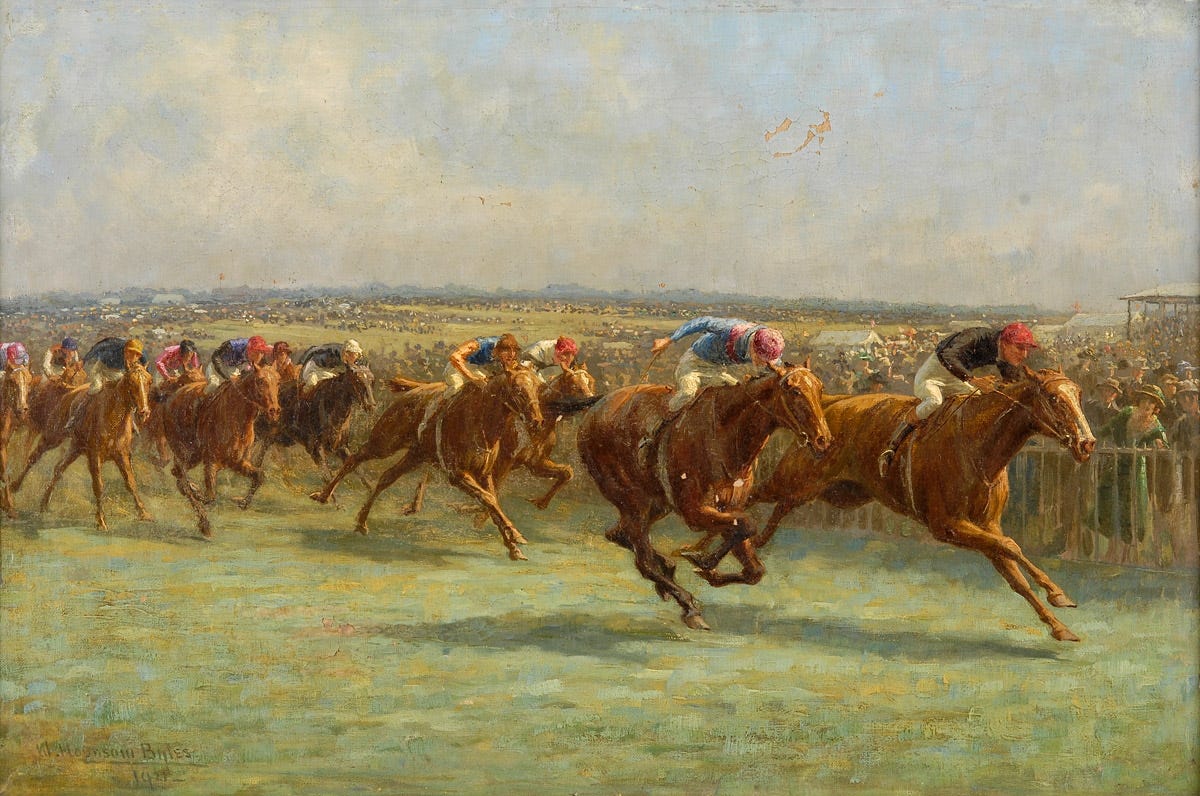
Mr. Bates is dazed. Stunned.
He and Sanborn emerge into the street blinking—to cope with the light, and, it seems, with the harsh truth. A short distance from the Western Union office they are met by an exultant Maxwell, who arrives grinning from ear to ear, already spending in his mind his share of the gigantic windfall. But John Bates wears a grim face and bursts the bubble: Flying Lill placed!
What? It takes Charley Maxwell a second, then he understands. Well of course he placed! “Charley turns on Louis [Sanborn] in a fury. ‘Don’t you know what the word place means?’ he roars.”
Here, for the non-betting public, I explain a technicality, for the entire story turns on it.
In a horse race, ‘to place’ means to come in second. But the verb ‘to place’ can also be used as a command to bet. Thus, if you give the cashier $25,000 and say, “Place it all on Flying Lill,” which is how Sanborn understood it, you are betting that Flying Lill will come in first. But if you tell the cashier, “Here’s $25,000 on Flying Lill to place”—what Maxwell wanted—you are betting that Flying Lill will come in second. This double use of the verb ‘to place’ explains the mistake.
Sanborn tries to make excuses, “but Maxwell will have none of it. He rakes that young man over the coals until [Sanborn] hangs his head in red-faced shame and humiliation.” Bates comes to Sanborn’s defense, explaining that he misunderstood it in the same way. So Maxwell now turns on Bates and lets him, too, have a piece of his angry mind. After some time of this, Maxwell finally cools off. Well, he says, this is clearly a mistake they will never make again. Can Mr. Bates raise more money?
That’s how it unfolds. Let us now explain the con.
The wire: the con, explained
Who’s the con artist, here?
Sanborn seems like a good candidate. He found Bates, he created a relationship with him, he suggested Bates as a replacement for ‘Mr. Brown’ (the alleged original capitalist in this undertaking), and he made the costly ‘mistake.’ Only one problem: Sanborn doesn’t have the money—it went to the suave gentleman running the horse poolroom. But that’s easily solved: assume that Sanborn and this gentleman are working together and will share the spoils, and you’ve got yourself a con.
This is in fact the case.
What, then, about Sanborn’s large corporation, which was to buy Bates’ store? Simple: no such thing exists. With his silver tongue and some fake credentials Louis Sanborn has—all by himself—simulated a corporation, the point of which is to ‘rope’ Bates and lead him by the nose to New York with the promise that ‘corporation lawyers’ will there finalize the deal. Once in New York, Sanborn makes a call and then reports to Bates that the lawyers—quite miraculously, as they don’t exist—are too busy, and thus creates a free day for the con to play itself out.
But we have only begun to explain this con.
For hasn’t Sanborn also conned his cousin Charley Maxwell? No, in fact. The entire thing is Maxwell’s plan. He calls the shots. Sanborn and the poolroom gentleman both answer to Maxwell. That may seem incongruous. Isn’t Maxwell just a Western Union employee? And isn’t the other gentleman running an aristocratic venue, making a fortune by collecting astronomical bets?
The answer to both questions is no.
First, Maxwell does not work for Western Union in the least. You may wish to object that Sanborn and Bates found Maxwell running New York’s central Western Union office. And you are half right. He was running it, but it’s not the Western Union office. Or an office of any kind. It is another simulation. The entire thing—office furnishings, teletypes, noisy staff, paper shuffling, wild activity—is a production, set up and performed by a team of first-rate actors entirely for an audience of one: John Bates. And the minute Bates steps out, the sign comes down and they all pack up and move out like a special forces platoon, leaving behind an empty floor space. This entire mob is organized and led by its ‘insideman’ or executive producer, Charley Maxwell (not his real name).
Since Maxwell’s telegraph office is fake, it cannot give him special information about which horse will win. But it does convince Bates that such information can be had. That’s why Maxwell stages the Western Union show.
But wait! Maxwell’s horses did win. What does that mean? As you’ve no doubt already guessed, it means that the horse-poolroom, with its cigar-smoking and whisky-drinking high-roller aristocrats, ticker tape, histrionic caller, cashier window, fat rolls of cash, and a long et cetera exists only in John Bates’ fertile imagination. It is another expert simulation, run by a separate team of actors belonging to Maxwell’s mob, whose only purpose is, once again, to create a world for Mr. Bates to inhabit.
Even the tens of thousands of dollars that Bates believes he saw others wager do not exist. It’s just a couple of thousand in large bills, placed on the outside of a great many paper rolls, to give the appearance of very large quantities of money. And the minute these monies are placed in the cashier’s safe they are taken out through a secret back door and discreetly recirculated to the fake high rollers for another round of fake wagers. This reduces the amount of real cash needed to stage the poolroom. Even so, the whole setup is quite expensive, but the $25,000 trimmed from Mr. Bates (almost $1.5 million in 2026) ain’t pennies. Everybody will get paid.
And there’ll be someone else tomorrow. Maxwell’s is a mature business, run with a carefully managed appointment book. The call that Sanborn placed when he arrived in New York, ostensibly to consult with the ‘corporation lawyers,’ was really to Charley Maxwell, to find out when exactly they could play for Bates. Maxwell found a time in his busy schedule of marks, all coming in from different places, brought in by an army of ropers just like Sanborn. So many suckers, so little time…
So that’s the wire.
In the next piece, I turn to the ethnography and theory of the con, the better to understand our own vulnerability to it.


Maurer, D. W. (1999). The big con: The story of the confidence man. Anchor. (Original work published 1940). (p.5)
Ibid., p.8
PBS. (n.d.). Racing in the Depression. American Experience.
https://www.pbs.org/wgbh/americanexperience/features/seabiscuit-racing-depression/
Billiard Congress of America. (2005). Billiards, revised and updated: The official rules and records book. Lyons Press. (p.3)
Polsky, N. (2006). Hustlers, beats, and others. Transaction Publishers. (Original work published 1967). (pp.108, 138)
Maurer, D. W. (1999). The big con: The story of the confidence man. Anchor. (Original work published 1940). (p.109)
The inflation calculation I am using is based on the consumer bundle, rather than the CPI.
https://www.measuringworth.com/dollarvaluetoday/result.php?year=1935&amount=20000&transaction_type=PURCHASE
Maurer, D. W. (1999). The big con: The story of the confidence man. Anchor. (Original work published 1940). (p.38)
Ibid., p.40
Ibid., p.37
Ibid.
Ibid., p.41
That was fascinating. Although the actual MO was way over my head.
I had to keep saying, "wait -- what?" going back and rereading the details.
The Sting is not accessible online unless you want to risk a Russian movie site, which I didn't trust (though I found that ironic). So I read the plot. Again, the convoluted layers of deception were overwhelming.
I suppose you are going to say that this is the point. We are powerless against grifters, who know human nature all too well.
But I did notice that the lure was based on cheating for profit. If the saying, "you can't cheat an honest man", has any reliability, the big con will only work on corrupt people trying to get rich(er).
https://ia800501.us.archive.org/19/items/joost-meerloo-rape-of-the-mind/%20Joost%20Meerloo_Rape%20of%20the%20mind.pdf
Joost Meerlo was a Dutch-American psychologist who was fascinated by mental coercion and wrote around 1946 I think 'The rape of the Mind'. You can read it online. Lots of examples from reality. It is yet some time since I read it. Very insightful. Well written.To me it seems very much related to your investigations.